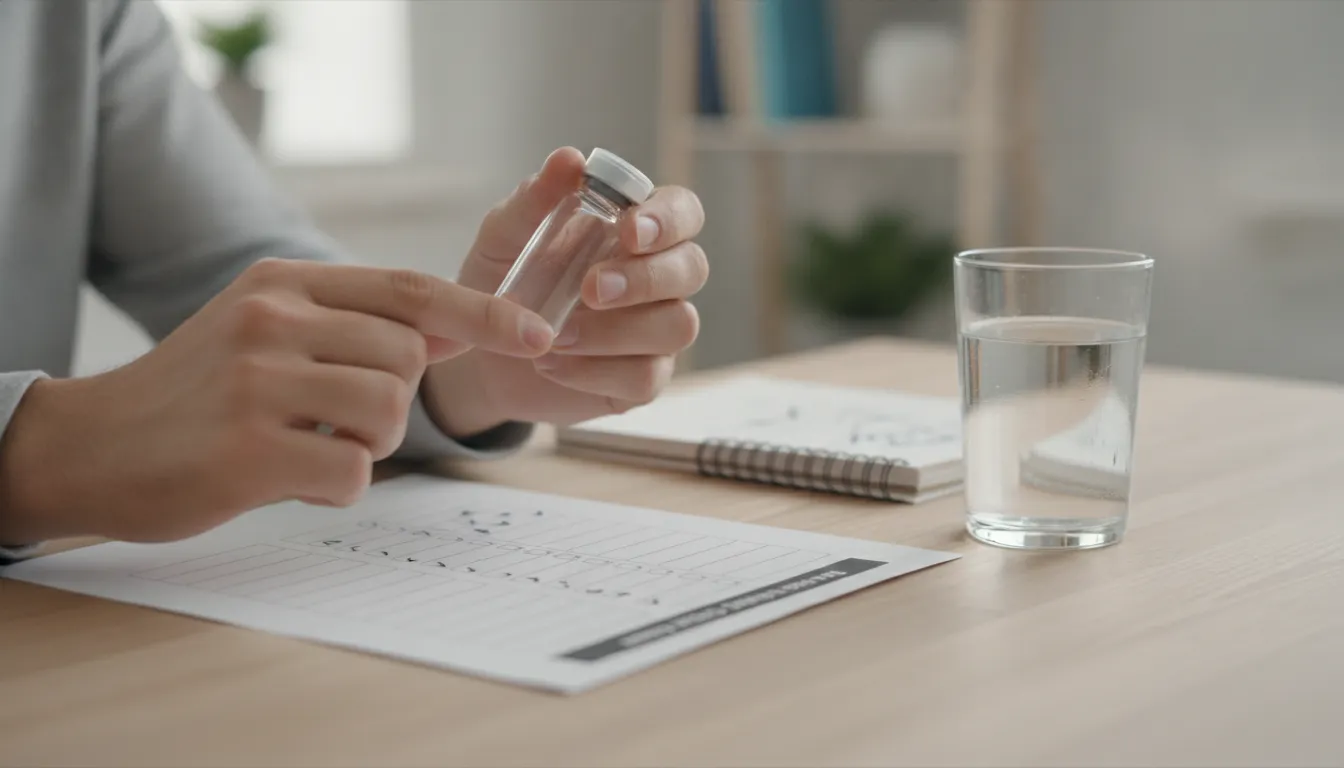
Compounded tirzepatide safety is not a yes-or-no label you can read off a website. A compounded product is prepared by a pharmacy or outsourcing facility rather than manufactured as an FDA-approved finished product. Some compounded drugs are prepared for an individual prescription, while 503B outsourcing facilities may produce batches under separate conditions. Before treatment, you need to know who prescribed it, which pharmacy made it, what the label says, how the dose is measured, and which symptoms should interrupt treatment.
See if you qualify for a clinician review
This guide is a checklist, not a promise that compounding is right for you. A licensed clinician has to decide whether any tirzepatide product fits your history. MetabolixMD offers clinician-guided weight-management plans, including tirzepatide options, only after that review. Nothing here replaces the prescribing information for an approved product or the instructions on a compounded label.
Key takeaways
- FDA-approved tirzepatide products are Zepbound and Mounjaro. Compounded tirzepatide is not FDA-approved for safety, effectiveness, or quality.
- FDA says tirzepatide is not on the current drug-shortage list or the 503B bulks list, which limits when a copy can be compounded.
- Ask who prescribed the product, which pharmacy will dispense it, and whether the prescriber documented a patient-specific reason.
- Confirm the concentration, the syringe marking, the beyond-use date, and the storage rules in writing before the first dose.
- Severe belly pain, signs of an allergic reaction, or a possible dosing error need prompt medical care, not a wait-until-the-next-visit plan.
What compounded tirzepatide is, and what it is not
Tirzepatide is the active ingredient in two FDA-approved medicines from Eli Lilly. Zepbound is approved for chronic weight management in certain adults. It is also approved for moderate to severe obstructive sleep apnea in adults with obesity. Mounjaro is approved to improve blood sugar in adults with type 2 diabetes, along with diet and exercise. Both are supplied as finished products with FDA-reviewed labeling.
A compounded drug is prepared by a pharmacy or outsourcing facility. It is not sold as that finished, approved product. The FDA's overview of compounded-drug risks is direct. The agency does not review compounded drugs for safety, effectiveness, or quality before they are marketed. A label may also omit directions that approved labeling must include.
Compounded does not mean generic, cheaper-but-equivalent, or "the same shot in a different bottle." An approved generic has to meet FDA approval standards. A compounded tirzepatide product has not gone through that review, even if the ingredient name matches the brand.
That is why compounded tirzepatide safety starts with the product in your hand. It does not start with headlines about brand-name trial results. Weight-loss percentages from Zepbound studies describe Zepbound used as labeled. They do not automatically transfer to a compounded vial, an oral drop, or a product that adds another ingredient.
How FDA rules changed after the tirzepatide shortage
During the national shortage, some pharmacies compounded tirzepatide so patients could keep receiving treatment. That window was temporary. FDA later determined the tirzepatide injection shortage was resolved, and the enforcement discretion tied to that shortage ended.
On April 1, 2026, FDA restated the conditions that still apply. In its update for GLP-1 compounders, the agency said tirzepatide and semaglutide do not currently appear on the 503B bulks list or on FDA's drug shortage list.
Two federal sections matter:
- Section 503A generally covers a state-licensed pharmacy or physician compounding for an identified patient after receiving a prescription. It may not regularly or in inordinate amounts make an “essentially a copy” of a commercially available drug. FDA considers the same active ingredient or ingredients, the same, similar, or easily substitutable strength, and the same route of administration. An exception requires the prescriber to determine and document a change that produces a significant difference for that individual patient. Adding vitamin B12 or another ingredient does not automatically establish that exception.
- Section 503B covers registered outsourcing facilities under separate conditions, including restrictions on essentially copying approved drugs and on using bulk substances. A bulk substance generally must be on the 503B bulks list, or the finished drug must be on FDA’s shortage list at the time of compounding, distribution, and dispensing. FDA stated on April 1, 2026, that tirzepatide was on neither list. That status should be rechecked before publication. Tirzepatide’s absence from those lists does not by itself determine whether a 503A pharmacy or physician meets every 503A condition.
FDA also said it may still act against products that are poor quality or otherwise unsafe, even when a compounding exemption is under discussion. A clinic website that says "pharmacies are regulated" is not the same thing as saying the finished vial was FDA-approved.
Rules can change. Before you start or refill, ask the prescriber to check the current FDA shortage status and the pharmacy's basis for compounding. Do not rely on a social post from last year.
Questions to ask the prescriber before treatment
A legitimate compounded prescription is an individual clinical decision. It is not something you should be able to buy from a checkout page with no clinician involved. Use this list at the visit, and write down the answers.
Why this product, for you
- Is an FDA-approved tirzepatide product appropriate and available for my goal?
- If we are considering a compounded product, what patient-specific change are you documenting, and why is that change significant for me?
- Which product name, strength, and route are you prescribing? Is it an injection, a capsule, or another form?
- Will I get the prescription in writing, including the pharmacy that is allowed to dispense it?
Your history
- Do I have a personal or family history of medullary thyroid carcinoma, or MEN2? Zepbound's label says tirzepatide caused thyroid C-cell tumors in rats. It says the human risk is unknown. It also says the drug is contraindicated in people with that history. A compounded product does not remove that concern.
- Have I had pancreatitis, gallbladder disease, severe stomach disease such as gastroparesis, kidney problems, or a serious allergic reaction to tirzepatide or an ingredient in the product?
- Am I pregnant, planning pregnancy, or breastfeeding? Approved labeling warns against using Zepbound in pregnancy because of potential fetal risk based on animal data.
- What other medicines do I take, including insulin or a sulfonylurea, that could raise the chance of low blood sugar?
If the visit never covers your history, other medicines, or a reason to use a compounded product instead of an approved one, pause. Our guide to what a weight-loss doctor reviews shows the kind of intake that should happen before any prescription is written.
What to verify about the pharmacy and the label
Oversight of a pharmacy is not the same as approval of a specific vial. Still, you can check the basics before you pay or inject.
- License. Ask for the dispensing pharmacy's legal name, state license number, address, and phone number. Look the license up on that state's board of pharmacy site. A 503B outsourcing facility should also be registered with FDA.
- Prescription required. Walk away from sellers that ship tirzepatide without a prescription, that will not name the pharmacy, or that only take payment through a social-media message.
- Exact contents. The label should name tirzepatide, the concentration (for example, milligrams per milliliter), the total volume, the lot or batch, the pharmacy, and a beyond-use date. If another ingredient was added, such as a vitamin, it should be listed too.
- No mystery salts. Approved tirzepatide products use the tirzepatide base in a finished formulation. Ask whether the compounded product uses that base and where the ingredient was sourced. If the pharmacy cannot answer, do not guess.
- Storage on the label. Confirm whether the vial stays refrigerated, whether it can sit at room temperature, and for how long. Do not use a product that arrived warm if the label says it must stay cold, and do not use it past the beyond-use date.
FDA’s current safety page on unapproved GLP-1 drugs reports more than 730 adverse-event reports involving compounded tirzepatide as of May 31, 2026. FDA notes that adverse-event reports do not establish that a product caused the event, and reporting may be incomplete. The figures are a reason to treat sourcing and instructions as part of safety, not paperwork.
Dosing, syringes, and storage mistakes to prevent
FDA has received reports of dosing errors involving incorrect measurement, conversion, or titration; some cases required medical attention or hospitalization. Compounded vials often come in different concentrations. Instructions sometimes say "units" on an insulin syringe. A unit is a syringe marking, not a standard milligram dose. The same number of units can be a very different dose if the concentration changes.
Before the first injection, ask the prescriber or pharmacist to show the measurement with your actual vial and syringe:
- Read the concentration on the label out loud, in milligrams per milliliter.
- Confirm the prescribed dose in milligrams, not only in units.
- Mark which line on your syringe matches that dose for this concentration.
- Ask what to do if the concentration changes on the next vial. Do not reuse the old unit number.
- Use a new sterile needle and syringe for every injection. Never share a pen or syringe.
- Write down the day and time you take it so a missed dose is not doubled by accident.
FDA’s reports include patients who took several times the intended dose after unclear directions or syringe mistakes. Some clinicians made conversion errors too. If you are unsure which line to draw to, stop and call the pharmacy. Guessing is the error.
Storage is part of the dose. A product that was left in a hot mailbox, frozen by mistake, or kept past its beyond-use date may not contain the amount you think it does. Ask what a damaged shipment looks like and who replaces it.
Oral products need their own questions. "Tirzepatide pill" can mean different things, and compounded oral forms are not the approved injection. If you are comparing forms, read tirzepatide pills versus injections separately, then bring the specific product name back to your clinician.
Side effects and symptoms that need a call
Nausea, vomiting, diarrhea, constipation, decreased appetite, and injection-site irritation are common with tirzepatide in approved-product labeling. They can also happen with a compounded product. Common does not mean you should push through severe symptoms.
Zepbound’s current prescribing information adds warnings and precautions that should be on your question list even when the product is compounded:
- Thyroid tumor symptoms. A lump in the neck, hoarseness, trouble swallowing, or shortness of breath needs evaluation. The boxed warning is about a risk seen in rats; it is not a statement that the drug has been shown to cause medullary thyroid cancer in people.
- Pancreatitis. Stop the medicine and get care if pancreatitis is suspected. Sudden, severe, persistent stomach pain, sometimes spreading to the back, with or without vomiting, is the pattern clinicians listen for.
- Gallbladder disease. Pain in the upper right abdomen, fever, or yellowing of the skin or eyes needs prompt assessment.
- Dehydration and kidney injury. Vomiting or diarrhea that keeps you from drinking can injure the kidneys. Ask how your clinician will monitor this if you already have kidney disease. Our separate overview of GLP-1 medicines and kidney disease covers questions to raise, without treating tirzepatide and semaglutide as the same drug.
- Allergy. Swelling of the face or throat, rash with breathing trouble, or a severe injection reaction needs emergency care. Do not take another dose while you wait to "see if it passes."
- Low blood sugar. This risk is higher if you also use insulin or a sulfonylurea. Shakiness, sweating, confusion, or a sudden fast heartbeat should be treated with your clinician's low-blood-sugar plan.
- Vision changes. Report unexpected vision changes to your clinician rather than waiting for a refill visit. Do not treat an older warning about suicidal ideation or behavior as a current Zepbound label warning; FDA requested its removal after finding no increased risk.
- Procedures and other medicines. Tell the anesthesia or procedure team that you use tirzepatide before general anesthesia or deep sedation. Do not combine another tirzepatide-containing product or GLP-1 receptor agonist unless your clinician specifically directs it.
A suspected dosing error needs immediate contact with the prescriber, pharmacist, or U.S. Poison Control at 1-800-222-1222, even if you are not sure how large the error was. Call emergency services for trouble breathing, fainting, confusion, severe persistent abdominal pain, repeated vomiting, or other severe symptoms. Bring the vial, the concentration, the syringe, and the time of the dose. The online intake is not an emergency-care channel. If you suspect a counterfeit or a product that skipped the prescription step, save the packaging and report it.
You can report a serious problem with a medicine to FDA through MedWatch at 1-800-FDA-1088. Reporting does not replace medical care.
A checklist you can take to the visit
Use one row per question. If an answer is "we'll send that later" or "every patient gets the same vial," treat that as unfinished, not as a yes.
| Question | What a clear answer includes | Pause if you hear this |
|---|---|---|
| Is an FDA-approved option appropriate? | A yes or no based on your history, access, and goal, with the product name | "Compounded is the same as Zepbound" or no discussion of approved options |
| Why compound for me? | A documented, patient-specific difference from the approved product | A standard package offered to every buyer, or no prescriber note |
| Who makes it? | Pharmacy legal name, license, address, and phone, matched to the label | No pharmacy named, or shipment from an unnamed seller |
| What is on the label? | Ingredient, concentration, volume, lot, beyond-use date, storage | Only a brand-style nickname, or concentration missing |
| How do I measure the dose? | Milligrams plus the syringe line for this vial, shown to you once | Units only, or "use the same units if the bottle changes" |
| How is it stored and shipped? | Temperature rules and what to do if the package is warm or late | No beyond-use date, or advice to freeze and thaw repeatedly |
| What side effects stop treatment? | Written red flags for allergy, severe stomach pain, dehydration, and dosing errors | "Side effects mean it is working; keep injecting" |
| Who do I call? | Phone numbers for the clinician and the pharmacy. Also, when to use emergency care. | Only a chatbot. Or no way to reach a licensed person. |
Compounded tirzepatide safety versus compounded semaglutide
Semaglutide and tirzepatide are both used in medical weight management. Both were compounded widely during shortages. They are not interchangeable. A safety article about one does not answer the other.
Semaglutide is a GLP-1 medicine. Tirzepatide acts on GIP and GLP-1 receptors. Their approved brands, doses, pens, and trial results differ. Compounded semaglutide has a separate problem with unapproved salt forms, which we cover in is compounded semaglutide safe. Do not copy those salt warnings onto tirzepatide, and do not copy tirzepatide trial results onto a semaglutide vial.
Switching from one approved medicine to the other is also a different decision. Timing, starting dose, and side effects belong in a switch visit. If that is your situation, start with switching from semaglutide to tirzepatide, then use this checklist only if a compounded tirzepatide product is actually being proposed.
What a careful program will and will not claim
A careful program will tell you that results vary, that medicine is one part of care, and that not everyone is a candidate. It will not promise a certain number of pounds, and it will not describe a compounded product as FDA-approved.
MetabolixMD's public pages describe clinician review and ongoing provider support. Plans can include semaglutide or tirzepatide, with medication priced into the plan. Insurance is not required. Those are service facts. They are not a claim that a compounded formulation matched Zepbound or Mounjaro in a trial. Eligibility, product, and dose still depend on the clinician who reviews your history.
Cost questions are reasonable. Ask what is included, what happens if the product or dose changes, and whether an approved product would be considered if it becomes the better fit. Pricing context sits in our GLP-1 medication cost guide, which is separate from the safety decision.
Contact MetabolixMD about clinician-guided care
Frequently asked questions
Is compounded tirzepatide FDA-approved?
No. Zepbound and Mounjaro are FDA-approved tirzepatide products. Compounded tirzepatide is not reviewed by FDA for safety, effectiveness, or quality before it is marketed.
Did the tirzepatide shortage make compounding safe?
No. A shortage can change when compounding is legally available. It does not turn a compounded vial into an approved medicine. FDA has said the tirzepatide injection shortage was resolved and that tirzepatide is not on the current shortage list or the 503B bulks list.
Can I buy compounded tirzepatide without a prescription?
Do not. Legitimate 503A compounding for an individual patient starts with a prescription. Sellers that skip clinician review, hide the pharmacy, or market through social media are red flags for illegally marketed, counterfeit, or dosing-risk products.
How long can I keep compounded tirzepatide?
Use the beyond-use date and storage instructions on your vial. Those dates are assigned by the pharmacy for that product. They are not the expiration date printed on an approved Zepbound pen, and they do not carry over when the concentration changes.
Are compounded tirzepatide pills the same as the injection?
No. Approved tirzepatide for weight management is an injection. A compounded capsule, dissolve-tablet, or drop is a different product with its own quality questions. Ask what evidence the prescriber is using for that specific form.
Bring the checklist to a real review
Compounded tirzepatide safety comes down to a few facts you can check. You need an individual prescription, a pharmacy you can identify, a label you can read, and a dose you can measure. You also need a plan for side effects and errors. If any of those are missing, an approved product or a different plan may fit better.
A MetabolixMD clinician can review your history and tell you whether a weight-management plan is appropriate. You can start with a free assessment. You will not be promised a specific medicine or a specific result.
Get guidance for your weight-management goals
Start with a free assessment. A licensed provider reviews your information and discusses care options when appropriate.
See If I Qualify