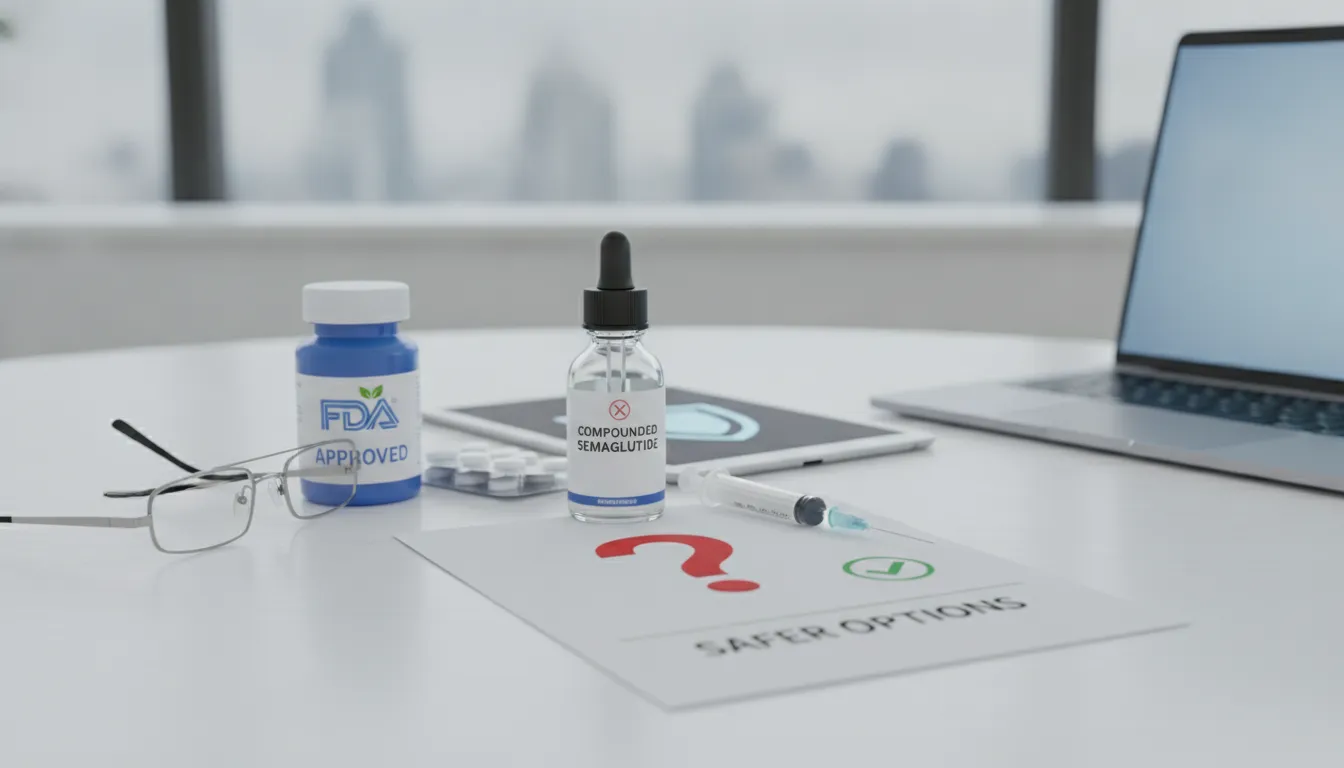
Weight management treatment should come with clear guidance, not guesswork. That matters when a medication is compounded, because the product may have different ingredients, concentrations, packaging, or directions from an FDA-approved medicine. Compounded semaglutide is not a generic version of Wegovy or Ozempic, and the FDA does not review each compounded product before it reaches patients. So, is compounded semaglutide safe? There isn’t one answer for every person or product. Understanding the known concerns can help you have a more informed conversation with your clinician. This article explains what to ask about the pharmacy, dose, syringe, storage, and possible side effects before using a compounded product.
Key Takeaways
- Know what compounded semaglutide is: It is prepared by a pharmacy and does not receive the same FDA review as an approved medicine. Ask your clinician why it may suit your individual needs.
- Verify the product and dose instructions: Confirm the pharmacy, ingredients, concentration, storage directions, and beyond-use date. Ask a pharmacist or prescriber to demonstrate how to measure and inject your specific dose.
- Make treatment decisions with your care team: Discuss FDA-approved options, your health history, potential side effects, and costs. Contact a healthcare professional promptly about a dosing error or severe symptoms.
What Is Compounded Semaglutide?
How compounding differs from FDA-approved manufacturing
Compounded semaglutide is prepared by a compounding pharmacy for an individual patient, usually after a healthcare professional writes a prescription. Compounding can involve combining or altering ingredients to meet a specific medical need. It differs from FDA-approved manufacturing, where a medicine is reviewed by the FDA for safety, effectiveness, and quality for its approved uses.
A compounded medicine is not FDA-approved, even if it contains semaglutide. The FDA does not review each compounded product before it is dispensed as it does an approved medicine. As a result, compounded products do not have the same FDA-reviewed evidence, labeling, or assurance of consistent quality as approved products. The FDA outlines concerns about unapproved GLP-1 drugs, including semaglutide products. If a clinician recommends a compounded medicine, ask why it may meet a need that an approved option cannot.
FDA-approved semaglutide products and their uses
Semaglutide is the active ingredient in several FDA-approved medicines, but their approved uses and directions differ. Wegovy is approved for chronic weight management in eligible patients and for reducing certain cardiovascular risks in some adults. Ozempic is approved for type 2 diabetes and certain cardiovascular and kidney risk reductions in specific adults with type 2 diabetes.
These products have distinct formulations, dosing instructions, and prescribing information. Having the same active ingredient does not make them interchangeable, or mean they are approved for the same purpose. A healthcare professional can review your health history and goals to determine whether an approved semaglutide medicine is appropriate for you. The product information explains the different approved uses of Wegovy and Ozempic. Follow the instructions for the specific medicine prescribed, and do not use one product’s dosing schedule for another.
Why compounded semaglutide isn’t a generic version
A compounded semaglutide product is not a generic version of Wegovy or Ozempic. Generic medicines are FDA-approved and must meet FDA standards, including requirements related to quality and equivalence to the approved reference medicine. Compounded medicines are prepared under different rules and do not go through that approval process to establish equivalence.
A label that says “semaglutide” does not confirm that a product matches an approved medicine in formulation, strength, quality, or performance. Concentrations and dosing instructions can also vary, so a dose prescribed for one product should not be assumed to apply to another. The FDA’s information on compounded semaglutide clarifies that compounded products are not FDA-approved versions of branded medicines. If you are offered one, ask your prescriber or pharmacist to explain how it differs and how to use it safely.
Why semaglutide sodium and acetate differ from the semaglutide base in approved medicines
FDA-approved semaglutide medicines use semaglutide as their active ingredient in a specific form. Some products marketed as compounded semaglutide may instead contain semaglutide sodium or semaglutide acetate, which are salt forms. These are not the same substance as the semaglutide base used in approved medicines.
The FDA says it does not know whether these salts have the same chemical and drug effects as the active ingredient in approved products, and is not aware of a lawful basis for using them in compounding. This uncertainty means that seeing “semaglutide” in a product’s name is not enough to know what it contains or whether it is comparable to an approved medicine. Read the FDA’s warning about unapproved GLP-1 drugs, and ask a licensed healthcare professional about the product’s ingredient and source before using it.
When a prescriber may consider compounding for an individual medical need
A prescriber may consider compounding when an FDA-approved medicine cannot meet a patient’s specific medical need, or when the approved medicine is not commercially available. The decision should be based on an individual assessment, not simply on price or convenience, or on a claim that a compounded product is identical to a brand-name medicine. Rules that apply to compounding can depend on the circumstances and may change.
If your prescriber raises this option, ask why an approved medicine may not be suitable or available and what is known about the proposed formulation. Find out which pharmacy will prepare it, what ingredient it uses, and how to follow its dosing and storage instructions. The FDA explains when compounding may be appropriate, while noting that compounded drugs are not FDA-approved. Your prescriber or pharmacist can help you understand the product-specific risks and instructions.
Is Compounded Semaglutide Safe?
The short answer: compounded products lack FDA approval for safety, effectiveness, or quality
Compounded semaglutide is not FDA-approved as a finished drug product. The FDA has not reviewed specific compounded formulations for safety, effectiveness, or quality before they are provided to patients. That does not mean every compounded product will cause harm, but it does mean it has not gone through the same premarket review as an FDA-approved medicine.
The FDA says compounding should generally be considered when a patient’s medical needs cannot be met by an approved drug, or when the approved drug is not commercially available. If a clinician discusses a compounded option with you, ask why it may suit your individual needs and what is known about its formulation. The FDA shares more in its safety information about unapproved GLP-1 drugs.
Why the same active ingredient doesn’t make products interchangeable
Seeing “semaglutide” on a label does not mean a compounded product is interchangeable with an FDA-approved medicine. Products can differ in their ingredients, concentration, packaging, and delivery method. These differences can affect how you measure and take a dose. Instructions for an approved injection pen may not apply to a compounded product supplied in a vial.
Before using a compounded product, confirm its exact formulation and how to take it with your prescriber or pharmacist. If you’re given a vial, ask for clear instructions on the dose and syringe measurement, and don’t guess if anything is unclear. The FDA’s information on unapproved GLP-1 drugs includes concerns about dosing errors with compounded products.
How compounding risks differ from semaglutide’s known side effects
Semaglutide can cause side effects such as nausea, vomiting, diarrhea, constipation, and abdominal discomfort. These are possible effects of the medicine. Compounded products raise separate questions, including whether the concentration and instructions are clear and whether the specific product’s quality has been reviewed through FDA approval.
For example, measuring a dose from a vial may require a syringe and careful attention to the product’s concentration. A misunderstanding about the dose or syringe markings can lead to an error. Ask your prescriber or pharmacist to show you exactly how to measure and inject your prescribed amount. The FDA also warns about dosing errors involving compounded semaglutide.
Correct these misconceptions: compounded doesn’t mean generic, FDA-approved, or equivalent
A compounded medicine is not a generic version of an FDA-approved drug. Generic medicines receive FDA review to show they meet requirements for quality and are equivalent to a reference medicine. Compounded medicines are prepared by pharmacies and are not reviewed as finished products through the same FDA approval process.
Likewise, a claim that a compounded product contains semaglutide does not establish that it is FDA-approved or equivalent to an approved medicine. Ask your healthcare professional to identify the exact product and explain why it may be considered for your needs. You can also review the manufacturer’s explanation of compounded semaglutide, which clarifies that compounded products are not the same as FDA-approved, commercially manufactured medicines.
Know the Risks of Compounded Semaglutide
Compounded semaglutide may carry risks related to how the medication is prepared, packaged, stored, and measured, in addition to the side effects associated with semaglutide. These details can vary by product. If a clinician prescribes a compounded product, ask the prescriber and dispensing pharmacist to explain how to use and store it, and what to do if you notice a problem.
Dosing errors from vial concentrations, syringe markings, and milligram-to-unit conversions
Some compounded semaglutide products come in vials, so you draw up each dose with a syringe. The concentration can vary, and syringe markings usually show volume rather than the amount of medication in milligrams. Confusing milligrams, milliliters, and syringe units can result in taking too much or too little.
The FDA has received reports of dosing errors involving patients and healthcare professionals, including errors with dose calculations and increases. Before your first injection, ask your prescriber or pharmacist for written directions that match your specific vial and syringe. Have them show you how to measure the dose, and repeat the instructions back to confirm you understand. Don’t calculate a dose, change it, or rely on directions from another product. The FDA’s safety information describes reported dosing errors and other concerns.
Product quality concerns: potency, sterility, and contamination
Compounded medicines are prepared by pharmacies for individual patients. They are not reviewed by the FDA before sale for safety, effectiveness, and quality in the same way as FDA-approved medicines. Formulation, concentration, ingredients, packaging, and delivery method may vary. As a result, a compounded product may not have the same consistency or instructions as an FDA-approved medicine.
Sterility matters for any medication that is injected. Contamination could cause an infection or other harm, while differences in preparation or concentration may affect the dose you receive. A product’s description or label alone can’t confirm its quality. Ask your prescriber or pharmacist where it was prepared, how it was checked, and who to contact with questions. The FDA explains that compounded drugs are not FDA-approved, even when they contain an ingredient also found in an approved medicine.
Storage, shipping, handling, refrigeration, and beyond-use dates
Storage instructions depend on the specific product and its packaging. Heat, light, or improper handling during shipping may affect a medication’s quality, so check the pharmacy’s directions as soon as your prescription arrives. If the package is damaged, the product arrives warm, or you’re unsure whether it stayed within the required temperature range, contact the pharmacy before using it.
Check the beyond-use date on the label, and ask how long the vial may be used after its first use. Follow the pharmacy’s instructions for refrigeration and handling, and don’t assume that one semaglutide product has the same storage rules as another. The FDA has raised concerns about shipping and refrigeration for compounded GLP-1 products. Its safety information also discusses contamination risks associated with using multi-dose vials beyond recommended time frames.
Counterfeit, mislabeled, or illegally marketed products from unverified sellers
A product advertised online or through social media may not come from a legitimate, licensed pharmacy. The FDA has reported compounded semaglutide products with false labels, including products linked to pharmacies that either did not exist or denied making them. A professional-looking package or a claim that a product is equivalent to an approved medicine does not verify its source or contents.
Avoid sellers that offer semaglutide without a prescription or won’t identify the dispensing pharmacy. Before using a product, verify the pharmacy’s license and contact details with your state pharmacy board. If the label, packaging, or seller raises questions, pause and contact your prescriber or pharmacist. Don’t inject a product you suspect may be counterfeit or mislabeled. The FDA’s alert on unapproved GLP-1 drugs provides examples of these concerns.
Common side effects and serious risks, including dehydration, gallbladder problems, and pancreatitis
Semaglutide can cause nausea, vomiting, diarrhea, constipation, and headache. Ongoing vomiting or diarrhea may lead to dehydration. Contact your care team if you can’t keep fluids down, feel faint, or have other symptoms that concern you. Semaglutide also carries warnings about possible gallbladder problems and pancreatitis.
Seek urgent medical care for severe or persistent abdominal pain, especially if it spreads to your back, or for signs of a serious allergic reaction, such as trouble breathing or swelling of your face or throat. Dosing mistakes or differences in a compounded product can add risks beyond the medication’s known side effects. Don’t change your dose to manage symptoms without speaking with your prescriber. The FDA’s safety alert describes reported dosing errors and related concerns.
What adverse-event reports can—and can’t—reveal about product safety
Adverse-event reports help regulators spot possible safety concerns, but a report alone can’t prove that a medication caused a symptom or complication. Reports may not include a person’s full health history, other medicines, exact dose, or product source. They also don’t show how often an event occurs among everyone who used the medication. Reporting may be incomplete, so the number of reports is not a complete count of problems.
Treat these reports as signals that may need further review, not as proof of cause or a measure of your individual risk. If you experience a problem, contact your healthcare professional and share the product name, pharmacy, dose, and timing of your injection. You or your clinician can also report a suspected medication problem to the FDA.
What the FDA Says About Compounded Semaglutide
The FDA distinguishes compounded medications from FDA-approved drugs. Its guidance focuses on how compounded products are reviewed, the risks it has identified, and the rules that may affect when a pharmacy can prepare them. Because regulations and shortage status can change, check current FDA information and ask your prescriber or pharmacist how it applies to your prescription.
Compounded drugs lack FDA approval, even when other oversight applies
Compounded semaglutide is not an FDA-approved version of a medication. Compounding involves preparing a medication for a particular patient, for example, by combining or changing ingredients. Compounded products do not undergo the FDA’s premarket review for safety, effectiveness, and quality required of approved drugs.
Some pharmacies and facilities that compound medications are subject to state or federal oversight. That oversight does not mean the FDA has approved a specific compounded product or confirmed that it performs like an FDA-approved medicine. The FDA explains this distinction in its guidance on unapproved GLP-1 drugs. If a clinician recommends a compounded product, ask why it is being considered for your individual needs and where it will be prepared.
FDA concerns about dosing errors, adverse events, and unapproved products
The FDA has received reports of dosing errors involving compounded semaglutide. Some involved patients measuring doses from multidose vials; others involved healthcare professionals calculating doses. Confusion can arise when a prescription lists a dose in milligrams but the syringe uses unit markings, or when products have different concentrations. Reported symptoms included nausea, vomiting, diarrhea, abdominal pain, and constipation. Some people needed medical care or hospitalization.
These reports are a reason for caution, but they do not show how often errors occur or prove that every compounded product causes harm. The FDA also warns about semaglutide products marketed without approval or obtained from questionable sources. Review the agency’s safety information on unapproved GLP-1 drugs, and contact your care team if the vial, label, or dosing instructions differ from what you were told to expect.
How 503A pharmacies differ from 503B outsourcing facilities, and why registration isn’t FDA approval
Section 503A pharmacies generally compound medications for individual patients based on prescriptions and are primarily overseen by state boards of pharmacy. Section 503B outsourcing facilities can compound medications without prescriptions for individual patients, but they must meet additional federal requirements, including current good manufacturing practices, FDA inspection, and adverse-event reporting.
These categories describe different oversight requirements. Neither means that the FDA has approved a compounded semaglutide product for safety or effectiveness. Registration as a 503B outsourcing facility is not product approval, and the FDA does not review each compounded formulation before it is marketed. The agency provides a list of registered outsourcing facilities. Ask the pharmacy which type of facility prepared your medication and what quality standards apply.
How drug-shortage status and changing rules affect when compounding is allowed
Federal law generally restricts compounding drugs that are essentially copies of commercially available medications, with certain exceptions. These can include a prescriber’s determination that a change is needed to address a specific medical need. A drug’s status on the FDA shortage list may also affect whether pharmacies can compound copies under certain circumstances.
Shortage listings and FDA policies can change, so the rules that apply to a product may shift over time. The end of a shortage does not automatically answer every question about an individual prescription, but patients and clinicians should not assume that previous conditions for compounding still apply. Check the FDA’s drug shortage database and current guidance on compounded GLP-1 drugs. Your prescriber or pharmacist can explain what applies to your situation.
Check FDA safety alerts and report adverse events or questionable products
Check FDA alerts for updates about compounded semaglutide, dosing concerns, and products the agency has identified as questionable. If you experience a possible side effect, make a dosing error, or suspect a product is counterfeit or mislabeled, contact your healthcare professional promptly. Seek urgent care for severe symptoms or a possible serious reaction.
Patients and healthcare professionals can report suspected adverse events or product-quality problems through the FDA’s MedWatch reporting program. Include details such as the product name, pharmacy or seller, dose, lot number if available, and when you used it. Reports can help the FDA identify potential safety signals, but they do not confirm that a product caused a particular reaction. Keep the packaging and prescription details in case your care team or the FDA needs them.
Reduce Risk if You’re Prescribed a Compounded Product
Compounded semaglutide is not FDA-approved. The FDA does not review compounded drugs for safety, effectiveness, or quality before they are marketed, so a prescription does not make a compounded product equivalent to an FDA-approved medicine. If a clinician discusses a compounded option with you, ask why it may fit your individual medical needs and what is known about the specific product.
Before using it, make sure you know who prescribed it, which pharmacy prepared it, how to measure and inject your dose, and how to store the medicine. Get instructions in writing, and keep them with the product. If the label conflicts with your care team’s directions, or you are unsure about a dose, pause and ask your prescriber or pharmacist before injecting. Don’t guess, convert measurements on your own, or follow instructions meant for a different product. The FDA’s guidance on unapproved GLP-1 drugs outlines precautions for patients prescribed compounded products.
Get an individualized assessment and prescription from a licensed healthcare professional
A clinician should review your health history, current medicines, and treatment goals before prescribing a compounded product. Ask why compounding is being considered and whether an FDA-approved option may be appropriate for you. Your assessment should include a chance to discuss potential benefits, risks, and follow-up, not just a quick purchase decision.
Confirm who is responsible for your care and how to reach them if you have questions or side effects. The FDA advises patients to get a prescription from a doctor and fill it at a state-licensed pharmacy. If you can’t identify the clinician or arrange follow-up, ask questions before starting. You can also seek another medical opinion if you’re not comfortable with the explanation or care plan.
Verify the dispensing pharmacy’s license, identity, and contact details
Ask for the pharmacy’s full legal name, address, and phone number. Then check its license with the state pharmacy board where it operates. A name or logo on a website or package does not, by itself, confirm that the pharmacy is licensed. The NABP pharmacy verification resource can help you check pharmacy credentials.
Keep the product label and pharmacy contact details somewhere easy to find. You should be able to speak with a pharmacist about the medicine, its ingredients, storage, and instructions. If the seller won’t identify the pharmacy, or the details don’t match the official license record, don’t use the product until you’ve discussed the discrepancy with your prescriber. Ask your care team to help verify the source if you’re unsure where to check.
Ask about the product’s source, formulation, concentration, storage, and beyond-use date
Ask which pharmacy prepared the product and what form of semaglutide it contains. Compounded products can differ in formulation, concentration, packaging, and delivery method. Don’t assume a product is interchangeable with an FDA-approved medicine because the label says “semaglutide.” Ask the pharmacist to explain the concentration and show you where to find the product’s beyond-use date.
Confirm whether the medicine needs refrigeration, how to handle it during travel, and what to do if it arrives warm or damaged. Ask how long a multi-dose vial can be used after opening, too. The FDA’s safety information addresses storage and contamination concerns with multi-dose vials. Follow the directions for your specific product, and contact the pharmacy if any instruction is missing or unclear.
Get written instructions for your dose and syringe measurement
Ask your prescriber or pharmacist for a written plan that states how much to inject, how often to inject it, and whether or when the dose may change. If the instructions use syringe units, ask them to explain how those markings correspond to your prescribed dose and the product’s concentration. Milligrams and syringe units are different measurements, so don’t calculate a conversion yourself.
Keep the plan with the medicine and compare it with the pharmacy label when you start and with each refill. If the directions don’t match, wait to inject until your prescriber or pharmacist clarifies them. The FDA has reported dosing errors with compounded injectable GLP-1 products, including errors involving syringe measurements. Clear, product-specific instructions can help you avoid confusion.
Ask your prescriber or pharmacist to demonstrate dose measurement and injection technique
Before your first injection, ask a healthcare professional to demonstrate how to measure the prescribed dose using the exact vial and syringe you received. Ask them to point out the correct syringe marking and explain each step. Then show the steps back to them so they can check that you’ve understood the instructions.
Don’t rely on a video that shows a different product, concentration, or syringe, since the directions may not match what you have. If a refill comes in different packaging or has a different concentration, ask for another demonstration before using it. The FDA recommends confirming the dose and schedule with a health professional or compounder. If you’re uncertain at any point, contact your care team rather than estimating.
Follow storage instructions and use a new sterile needle and syringe for each injection
Follow the storage directions provided for your product, including instructions about refrigeration, light, and handling during travel. Ask a pharmacist what to do if the medicine has been stored outside the recommended range, arrives warm, or appears different from its description. Keep it safely away from children and anyone who might mistake it for another medicine.
Use a new sterile needle and syringe for every injection. Never share them, even if you change the needle, and dispose of used supplies in an appropriate sharps container. Reusing or sharing injection supplies can increase the risk of infection. The FDA advises using a new, sterile needle and syringe for each dose. Follow the product’s specific directions for how long a vial can be used after opening, and ask the pharmacist if they’re unclear.
Avoid sellers that don’t require a prescription or use unverified websites and social media
Avoid sellers that offer semaglutide without a prescription, skip a meaningful medical assessment, or advertise through unverified websites or social media accounts. Be cautious of claims that a compounded product is identical to an FDA-approved medicine, unusually low prices, vague pharmacy details, or promises of specific results. A professional-looking website or package alone can’t confirm a product’s source or quality.
Before paying, make sure you know which licensed clinician is overseeing your care and which pharmacy will dispense the medicine. If a seller won’t provide those details or pressures you to buy quickly, step away and ask your healthcare professional for guidance. The FDA lists warning signs for unapproved GLP-1 products, including no prescription requirement and no access to medical follow-up. Don’t use a product if you can’t confirm its source.
Contact your care team before changing your dose, product, or schedule
Check with your prescriber or pharmacist before increasing or decreasing your dose, changing your injection day, restarting after a break, or switching products. Formulations, concentrations, and instructions can differ, even when products contain semaglutide. A dose measurement that was correct for one product may not apply to another.
If you miss a dose or think you may have injected the wrong amount, ask your care team what to do. Don’t take an extra dose or change your schedule to compensate unless they tell you to. Keep the package nearby when you call, and share the product name, label details, dose, and time of your last injection. The FDA advises patients to confirm doses and schedules with a health professional or compounder. Contact your care team promptly if you notice a new or concerning symptom.
Compare FDA-Approved Options and Other Treatments
Semaglutide is one possible treatment for chronic weight management, but it isn’t the only one. The right choice depends on your health history, treatment goals, preferences, and access to care. Your provider can help compare options and explain what to expect before you begin.
FDA-approved semaglutide products and their labeled uses
Wegovy and Ozempic both contain semaglutide, but they have different FDA-approved uses and product labeling. Wegovy is approved for chronic weight management in eligible patients and to reduce certain cardiovascular risks in some adults with overweight or obesity and cardiovascular disease. Ozempic is approved to treat type 2 diabetes and reduce certain heart and kidney risks in some adults with type 2 diabetes. Having the same active ingredient doesn’t make the products interchangeable. Ask your prescriber which product, if any, fits your needs, and review the FDA-approved uses for semaglutide products together.
Other FDA-approved prescription medicines for chronic weight management
Semaglutide isn’t the only prescription option. Depending on your health profile, your clinician may discuss medicines such as orlistat, phentermine-topiramate, or naltrexone-bupropion. These medicines work differently, and each has its own eligibility criteria, potential side effects, and precautions. Some may not be suitable with certain health conditions or other medications. Your clinician can explain which options are appropriate and how their benefits and risks compare for you. Stanford Medicine’s overview of prescription medicines for weight management is another resource to help you prepare questions for your appointment.
Compare product testing, labeling, formulation, and delivery
FDA-approved medicines are reviewed by the FDA for safety, effectiveness, and quality before they can be marketed. Compounded drugs are prepared by a pharmacy for specific medical needs, but they aren’t FDA-approved and don’t go through that same review. Compounded products may differ in concentration, formulation, packaging, or how they’re taken. So, a product labeled as semaglutide shouldn’t automatically be considered equivalent to an FDA-approved medicine. Before starting any prescription, ask your provider or pharmacist what product you’ll receive and how to use it. The FDA’s information on unapproved GLP-1 drugs explains why these differences matter.
Consider how cost, insurance, and availability shape treatment choices
Cost and coverage can affect which treatment works for your budget. Your out-of-pocket cost may depend on your insurance plan, the reason the medicine is prescribed, pharmacy pricing, and coverage requirements such as prior authorization. A plan may cover a medicine for one approved use but not another, so check your benefits before starting. Availability can also change. Ask your insurer and care team about the expected cost, refill process, and what to do if your prescription becomes difficult to fill. If a lower-priced product is offered, confirm its source and discuss it with your prescriber rather than choosing based on price alone.
Pair medication with nutrition, physical activity, behavioral support, and other care
Medication is one part of a treatment plan, not a substitute for ongoing care. Your provider may recommend nutrition support, physical activity, sleep strategies, or behavioral counseling alongside medication. Choose practical steps that fit your work schedule, family responsibilities, health needs, and preferences. Regular follow-up can help your care team monitor how you’re doing, address side effects, and adjust your plan when needed. Ask whether a registered dietitian, structured activity plan, or counseling could support your goals. The semaglutide patient safety information also highlights the role of lifestyle changes alongside medication.
Discuss Treatment Options With Your Provider
Choosing a treatment involves more than comparing medications. Your provider needs to understand your health history, what you hope to achieve, and what feels realistic alongside work, family, and other responsibilities. Bring a current list of medicines and supplements, and share what you’ve tried before, including what helped and what was hard to continue. This gives your care team useful context for discussing possible benefits, risks, and next steps.
If compounded semaglutide comes up, ask why it’s being considered and whether an FDA-approved treatment is appropriate and accessible for you. Compounded medicines are not FDA-approved for safety, effectiveness, or quality. The FDA advises patients to get a prescription from a doctor and fill it at a state-licensed pharmacy. Ask your provider to explain the specific product and how its instructions differ from those for an approved medicine.
Before your appointment, write down questions about side effects, monitoring, pregnancy plans, cost, and what to do if a medication becomes unavailable. Ask for clear instructions and the best way to reach your care team between visits. You should leave knowing what the plan is, what to watch for, and whom to contact with concerns.
Share your health history, medicines, goals, and past treatment experiences
Tell your provider about your health conditions, allergies, past surgeries, and relevant family medical history. Share every medicine and supplement you take, including over-the-counter products and any treatments used for weight management. A complete list helps your care team consider how a new treatment may fit with your current care.
Be open about your goals and past experiences. You may be looking for help with weight management, metabolic health, or a health measure your provider is tracking. Explain what you have tried, what worked, and what was difficult to maintain. If your schedule, caregiving responsibilities, or access to a gym affects your routine, mention that too. The more your provider understands about your day-to-day life, the more practical the treatment conversation can be.
Ask whether an FDA-approved option is appropriate and accessible
Ask whether an FDA-approved medicine is suitable for your health needs and, if so, how you can access it. Approval applies to a specific product and its labeled uses, so ask your provider to explain which option they are discussing and why. An approved medicine may not be right for everyone, and your health history can affect the decision.
Access and cost matter, too. Ask whether your insurance covers the treatment, whether you need prior authorization, and what you may pay out of pocket. If a medicine is unavailable or unaffordable, discuss other approved treatments and care approaches rather than switching on your own. You can review approved products and their labeling in the FDA’s drug database.
Discuss expected benefits, side effects, monitoring, and follow-up
Ask what the treatment is intended to help with, how your provider will track your progress, and when you should check in. Discuss common side effects, as well as symptoms that need prompt medical attention. Semaglutide products can carry serious risks, and your provider can explain how your health history may affect your care plan.
Before starting, confirm who to contact with questions and whether you’ll need follow-up visits, tests, or health checks. Ask what to do if side effects make it difficult to eat or drink, or interfere with work, exercise, or daily activities. Don’t change your dose or stop treatment without medical guidance. The FDA shares information about reported dosing errors with compounded GLP-1 drugs, which is one reason to clarify instructions before using a product.
Discuss pregnancy, pregnancy plans, and health conditions that may affect treatment
Tell your provider if you are pregnant, breastfeeding, trying to become pregnant, or planning a pregnancy. These details can affect whether a medicine is appropriate and whether your treatment plan needs to change. If pregnancy is possible, ask what precautions to take and how far in advance to discuss stopping or changing medication. Don’t assume that a medicine used for weight management is suitable during pregnancy.
Also share any health conditions that may affect treatment, including a history of digestive, gallbladder, pancreatic, kidney, or endocrine problems. Your provider can review the information for the specific medicine and explain which risks are relevant to you. Read the patient information for any product prescribed, and bring questions to your appointment. The FDA’s drug database links to approved product labeling.
Confirm the pharmacy, product source, storage needs, and written dosing plan
Before filling a prescription, confirm the pharmacy’s name, location, and contact information. If your provider prescribes a compounded product, ask who prepared it, what formulation and concentration it contains, and how to store it. Check the beyond-use date and ask what to do if the package arrives damaged or the product has not been kept at the required temperature.
Get the dose and directions in writing, including how to measure it with the exact syringe supplied. A dose stated in milligrams may require a separate volume measurement, so don’t try to convert units yourself. Ask your prescriber or pharmacist to demonstrate the measurement and injection steps, then repeat the instructions back to check that they’re clear. The FDA recommends contacting your doctor with questions about compounded GLP-1 medicines.
Ask about total cost, coverage changes, and what to do if treatment becomes unavailable
Ask for an estimate of the full cost, including medication, appointments, lab work, and supplies. Find out whether your insurance covers treatment, whether coverage depends on specific criteria, and whether you’ll need to renew authorization. If you use a telehealth service, clarify which services are included and how to contact your care team between appointments.
Ask what to do if your insurance changes, the medication becomes unavailable, or the cost no longer fits your budget. Your provider can discuss alternatives and help plan any transition. Don’t switch products, adjust your dose, or stretch doses to make a supply last without medical advice. If you’re changing from a compounded product, tell your provider exactly what you used and when you last took it. They may need to confirm the product’s concentration and the dose you received before recommending next steps.
Know When to Get Medical Help
Some symptoms while using semaglutide need prompt medical attention. If you use a compounded product, tell your care team, and don’t wait for a scheduled appointment if symptoms are severe or getting worse.
Seek urgent care for severe or persistent symptoms, an allergic reaction, or signs of serious complications
Seek urgent medical care if you faint, feel confused, or go eight hours without urinating. These can be signs of severe dehydration. Sharp pain in your upper abdomen, especially if it spreads to your back, or gastrointestinal symptoms that are severe, worsening, or not improving also warrant prompt medical evaluation. These symptoms can have different causes, so a healthcare professional can help determine what care you need. Stanford Medicine includes these warning signs in its overview of compounded GLP-1 safety concerns.
Call emergency services for signs of a serious allergic reaction, such as trouble breathing or swelling of your face, lips, tongue, or throat. If you’re unsure what to do, contact your clinician or pharmacist. For symptoms that feel life-threatening, seek emergency care rather than waiting for a callback.
Contact a healthcare professional promptly after a dosing error or suspected use of a counterfeit or questionable product
If you inject more than prescribed, use the wrong amount, or aren’t sure how much you took, contact your prescriber or pharmacist promptly, even if you feel well. Ask what to do before taking another dose. Compounded products may have different concentrations, and measuring a dose can involve converting milligrams to syringe units. The FDA has received reports of dosing errors involving both patients and healthcare professionals.
Contact your care team if a product came from an unfamiliar seller, has unclear labeling, or looks different from what you were prescribed. Don’t use a product you suspect may be counterfeit or improperly stored. Keep its vial, packaging, and receipt, if available, so your clinician or pharmacist can review them. Seek urgent care if you develop severe symptoms.
Tell your care team the product name, source, dose, and time of your last injection
When you contact a clinician, share the product’s exact name and where you obtained it, including the pharmacy or seller. Have the concentration on the label ready, if listed. Explain your prescribed dose, how you measured it, when you last injected, and whether you may have taken too much or too little. If you don’t know a detail, say so rather than guessing.
Bring the vial, box, prescription label, and dosing instructions to an appointment or emergency visit. This information can help your care team identify the product and decide what to do next. The FDA advises patients to confirm their dose and schedule with a health professional or compounder. Don’t change your dose or schedule without medical guidance.
Frequently Asked Questions
Is compounded semaglutide the same as Wegovy or Ozempic?
No. Compounded semaglutide is not an FDA-approved generic or an FDA-reviewed equivalent of Wegovy or Ozempic. Products can differ in formulation, concentration, packaging, and instructions. Ask your prescriber or pharmacist which specific product you have and how to use it.
Does “compounded” mean a medication is unsafe?
Not necessarily, but compounded semaglutide does not go through the FDA’s premarket review for safety, effectiveness, and quality. That means there is less FDA-reviewed information about the specific product. If your clinician recommends it, ask why it may meet your needs and what is known about its source and formulation.
How can I avoid a dosing mistake with a compounded vial?
Ask your prescriber or pharmacist to write down your exact dose and show you how to measure it with the syringe supplied. Milligrams, milliliters, and syringe units are different measurements, so don’t convert them or change your dose on your own. If the label and your instructions don’t match, check with your care team before injecting.
Can I buy compounded semaglutide online without a prescription?
Avoid sellers that offer it without a prescription or won’t identify the clinician and pharmacy involved. Verify the pharmacy’s license and contact details, and ask your prescriber to review the product before you use it. A website or package alone cannot confirm a product’s source or contents.
When should I contact a healthcare professional after using semaglutide?
Contact your care team promptly if you may have taken the wrong dose, have persistent vomiting or diarrhea, or develop symptoms that concern you. Seek urgent medical care for severe or ongoing abdominal pain, signs of serious dehydration, or trouble breathing or swelling of the face or throat. Keep the product packaging and dose details available when you call.
Get guidance for your weight-management goals
Start with a free assessment. A licensed provider reviews your information and discusses care options when appropriate.
See If I Qualify