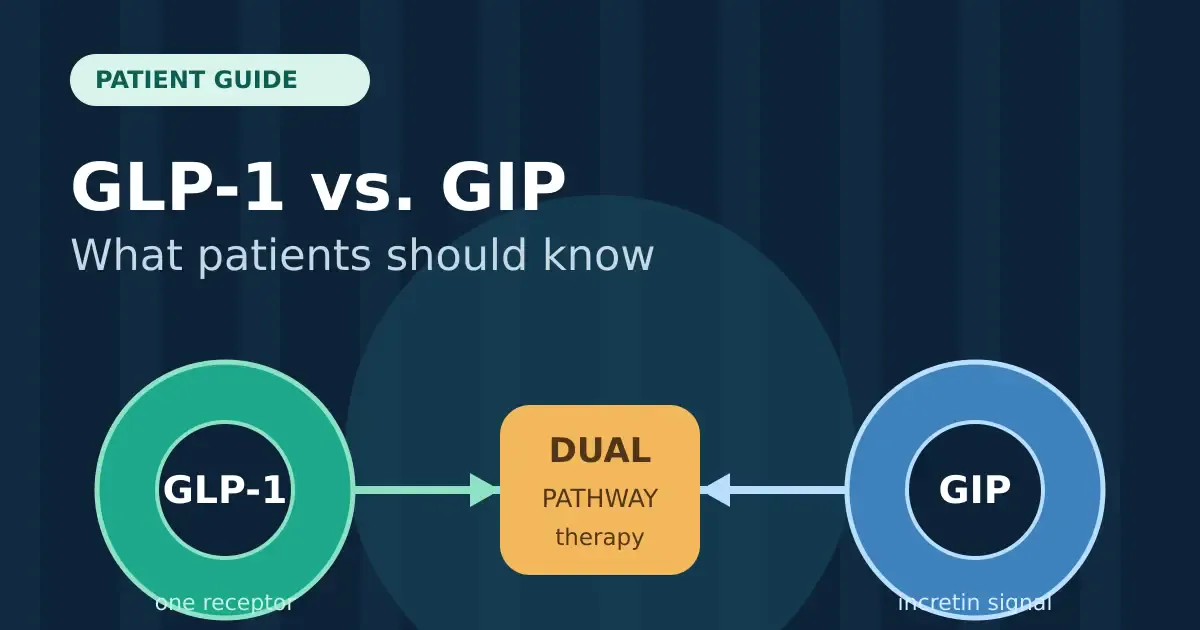
People researching medical weight management often ask, what is the difference between GLP-1 and GIP treatment? The short answer is that GLP-1 and GIP are different naturally occurring gut hormones, while some prescription medicines act on one pathway and others act on both. That distinction can affect how a medicine is described, but it does not tell you which option is appropriate for you.
In current weight-management conversations, “GIP treatment” usually refers to a medicine that activates both the GIP and GLP-1 receptors, rather than a GIP-only medicine. The right choice depends on your health history, current medicines, treatment goals, risks, and a licensed provider’s review. This guide explains the difference without trying to predict an individual response or recommend a dose.
What are GLP-1 and GIP?
GLP-1 and GIP are incretin hormones. After you eat, they help your body coordinate signals related to blood glucose and digestion. Prescription medicines can copy or strengthen some of those signals, but they are not interchangeable with the hormones made by your body.
- GLP-1 stands for glucagon-like peptide-1. GLP-1 receptor agonists can increase glucose-dependent insulin release, reduce glucagon signaling, slow stomach emptying, and influence appetite-related pathways.
- GIP stands for glucose-dependent insulinotropic polypeptide. GIP is another incretin that can support glucose-dependent insulin secretion. In some medicines, GIP activity is combined with GLP-1 activity.
- Dual-pathway treatment means a medicine activates both GIP and GLP-1 receptors. Tirzepatide is an example of a prescription medicine labeled as a GIP and GLP-1 receptor agonist.
These mechanisms are simplified descriptions, not a way to diagnose a condition or forecast how someone will respond. A provider must consider the complete label, your medical history, and your current medicines.
GLP-1-only versus dual GIP/GLP-1 treatment
A GLP-1-only medicine primarily activates the GLP-1 receptor. A dual GIP/GLP-1 medicine activates both receptor pathways. That is the central difference patients are usually asking about when they compare GLP-1 treatment with “GIP treatment.”
| Pathway description | What it means | What a provider still needs to review |
|---|---|---|
| GLP-1 receptor agonist | The medicine is designed to activate the GLP-1 receptor pathway. | Indication, health history, other medicines, contraindications, tolerability, and follow-up plan. |
| Dual GIP/GLP-1 receptor agonist | The medicine is designed to activate both the GIP and GLP-1 receptor pathways. | The same safety and eligibility review, plus whether the labeled option fits the patient’s needs. |
| Personalized treatment decision | “More pathways” does not automatically mean “better” for every person. | Goals, risks, side effects, medication interactions, monitoring, and the possibility that the plan may need adjustment. |
Which medicines are GLP-1 medicines, and which involve GIP?
Medication names can make the conversation confusing. Semaglutide is a GLP-1 receptor agonist. Tirzepatide is a dual GIP and GLP-1 receptor agonist. Brand names, formulations, approved uses, and labeling can change, so patients should rely on the current prescribing information and their prescriber rather than a social-media comparison chart.
For example, the FDA prescribing information for Wegovy (semaglutide) describes its mechanism and labeled uses, while the FDA prescribing information for Zepbound (tirzepatide) identifies tirzepatide as a GIP and GLP-1 receptor agonist. FDA approval for a particular use does not mean the medicine is appropriate for every patient, and it does not replace individualized medical advice.
Does dual-pathway treatment work better?
That question cannot be answered responsibly with a blanket promise. Clinical trials may compare medicines in specific populations and under specific protocols, but a trial result is not a guarantee for an individual. Results can also be affected by the condition being treated, the study design, follow-up length, adherence, and the outcomes researchers measured.
A provider may discuss the evidence for a particular medicine, but “more effective on average in one study” is not the same as “best for you.” A plan also has to be tolerable, safe with your other medicines, and appropriate for your health history. Do not switch, combine, stop, or change a prescription based only on a comparison article.
What the pathway difference does not tell you
The GLP-1 or GIP label describes a medicine’s pharmacology. It does not answer every practical question about treatment. Two people can discuss the same medication and still receive different recommendations because their diagnoses, laboratory results, other medicines, pregnancy considerations, prior side effects, and treatment goals are different.
The pathway also does not tell you how quickly you will notice a change, whether you will tolerate a medicine, or whether a clinician will recommend it. Those questions depend on the specific product and its labeling, the person taking it, and the follow-up plan. Be cautious with online claims that turn a complex treatment decision into a ranking, a guaranteed timeline, or a one-size-fits-all dose.
It can help to separate three questions during an appointment:
- What does the medicine do? This is the pathway and mechanism question.
- Is it appropriate for me? This is the health-history, medication, safety, and labeled-use question.
- How will we monitor it? This is the follow-up, symptom, and adjustment question.
Keeping those questions separate can make a conversation more useful than asking which pathway is “stronger.” If you are still learning the basics, MetabolixMD also has a separate overview of GLP-1 medication side effects; that article covers common symptoms and warning questions rather than comparing hormone pathways.
What side effects and safety questions should patients ask?
GLP-1 and dual GIP/GLP-1 medicines can cause digestive symptoms such as nausea, vomiting, diarrhea, or constipation. The likelihood and severity can vary. Some symptoms may improve, while persistent or severe symptoms need medical attention. The FDA labeling contains important warnings, limitations, and instructions that are more specific than a general article can be.
Before starting or changing treatment, ask a licensed provider:
- Which medication and indication are being considered, and why?
- Could my medical history or current medicines create a safety concern?
- What symptoms are expected, and which symptoms should prompt a call?
- How will follow-up, tolerability, and relevant health information be monitored?
- What should I do if I cannot keep fluids down, have severe abdominal symptoms, or miss a dose?
- What is the plan if the medicine is not tolerated or does not fit my goals?
Bring a complete medication and supplement list to the discussion, including medicines prescribed by another clinician. Tell the provider about relevant diagnoses, allergies, previous reactions, and any planned procedure or pregnancy. Do not assume that a medicine is safe simply because it is discussed as a weight-management treatment, and do not omit information because an online form seems brief.
Day-to-day logistics matter, too. Ask how the treatment is taken, how it should be stored, what to do about a missed dose, how follow-up is handled, and whom to contact if symptoms change. The answer may be specific to the product and the prescriber’s instructions. Never use another person’s medicine or copy another person’s dosing schedule.
For an overview of how virtual care can fit into a broader treatment conversation, see MetabolixMD’s guide to GLP-1 telehealth weight-management care. It does not replace a clinical evaluation, but it can help you prepare questions about intake and follow-up.
Seek urgent care for severe or rapidly worsening symptoms. Do not wait for an online intake response when you may have a medical emergency.
How a provider-guided decision works
A responsible treatment conversation is broader than choosing “GLP-1” or “GIP.” A provider may review your health history, diagnoses, allergies, current medicines, pregnancy status or plans when relevant, prior treatment experience, and symptoms. The provider can then explain whether a labeled treatment option is appropriate, what monitoring may be needed, and when follow-up should occur.
If you are exploring options, you can review MetabolixMD’s provider-guided peptide care information and bring your questions to the clinical intake process. The page is an educational starting point, not a promise that a specific medication or treatment will be recommended.
How to prepare for a treatment discussion
You do not need to arrive with a decision already made. A productive appointment can start with a short list of facts and questions. Write down why you are seeking care, what you hope to improve, and what concerns you have about side effects or the routine. If your goals include weight management, describe the broader context rather than focusing only on a number: sleep, mobility, metabolic health, appetite, or another outcome may be important to you and your clinician.
Gather the names and directions for your prescription medicines, over-the-counter products, and supplements. Include medications from other providers and note any allergies or previous reactions. Bring relevant medical records when available, including diagnoses or recent testing your clinician has asked you to share. If you are pregnant, planning a pregnancy, breastfeeding, or considering a procedure, say so during the review because those details may affect the discussion.
It is also reasonable to ask how the provider will communicate after the initial review. Clarify who answers medication questions, what follow-up looks like, which symptoms should be reported promptly, and what happens if the initial option is not a fit. These questions focus on continuity and safety rather than treating a medication comparison as a promise. A provider-guided process should leave you with clear next steps and a way to ask for help.
The bottom line
GLP-1 and GIP are different incretin hormones. GLP-1 medicines activate the GLP-1 receptor, while medicines commonly described as GIP treatments may activate both GIP and GLP-1 receptors. That mechanism difference is useful background, but it does not determine the right choice for every patient. A licensed provider should match the current FDA-labeled information with your health history, goals, safety considerations, and follow-up needs.
This article is for general education and is not a diagnosis or a substitute for care from a qualified clinician. Medication availability, labeling, and recommendations can change. Talk with a licensed provider before starting, stopping, combining, or changing prescription treatment. Ask for current product information whenever your plan or circumstances change.
Start with a provider-guided intake to discuss your options
Want more context first? Review MetabolixMD’s peptide-care information and write down the questions you want to ask your provider.
Sources
Get guidance for your weight-management goals
Start with a free assessment. A licensed provider reviews your information and discusses care options when appropriate.
See If I Qualify