What are peptides used for? The honest answer depends on which peptide you mean. Some are signals your body already makes. Some are medicines with a named use, a studied dose, and a defined group of patients. Others are wellness or research products whose claims have not been tested the same way. Sorting those three groups is the useful first step before you decide whether a provider conversation makes sense.
What are peptides used for, in practice?
A search for peptide uses usually mixes three different ideas. The first is biology. Short chains of amino acids help cells pass signals. The second is medicine. A specific peptide drug is prescribed for a specific condition. The third is a product marketed for energy, recovery, skin, or performance without that same level of evidence.
Those ideas share a word and almost nothing else. A peptide your pancreas releases after a meal is not interchangeable with a vial sold online. A prescription medicine is not interchangeable with a cream that lists a peptide among its ingredients. Before you compare benefits, name the substance and the setting.
If you are still sorting the basic definition, start with what a peptide is. This page picks up after that and looks at uses. It does not cover safety in detail, and it does not walk through a weight-loss plan. Those are separate questions.
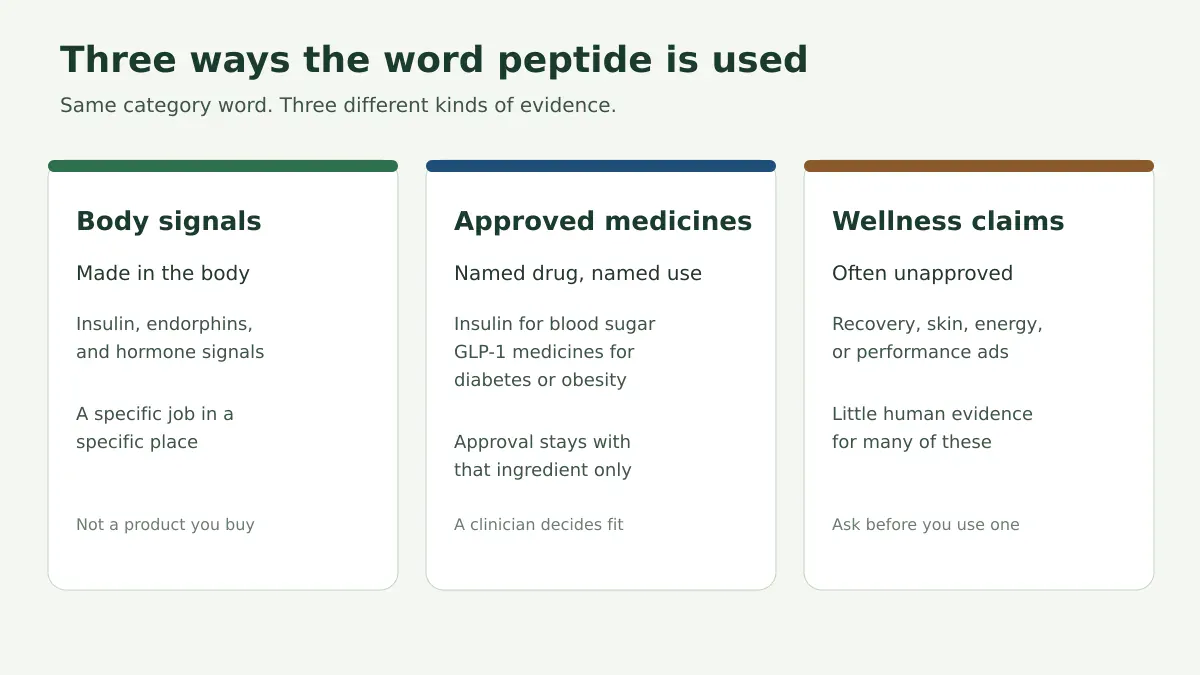
Diagram comparing three peptide categories, body signals, approved medicines, and wellness claims
The same word covers body signals, approved medicines, and wellness claims. Only the middle group has a named, studied use.
Signals the body already makes
Your body builds many peptides on its own. Harvard Health describes them as short amino-acid chains that help run hormone activity, immune defense, tissue repair, inflammation, and digestion. Each sequence does a narrow job. Belonging to the peptide family does not mean one molecule can stand in for another.
Three everyday examples show how specific those jobs are, and why one peptide cannot stand in for another.
- Insulin is a peptide hormone the pancreas releases to help regulate blood sugar.
- Endorphins are peptides the nervous system releases that can blunt pain signals and ease stress.
- Growth hormone-releasing hormone is a peptide signal that tells the pituitary gland to make and release growth hormone.
Food proteins also supply amino acids the body can use to build its own peptides. Eating protein is not the same as injecting a manufactured peptide. It does not reproduce the effect of a prescription medicine. The body's own signals depend on timing, location, and the rest of the system around them.
That is why a grocery-store claim and a clinic claim should not be read the same way. A yogurt that mentions peptides is talking about food. A vial is talking about a substance someone chose to make, dose, and deliver. The word on both labels does not make them the same intervention.
Where peptide medicines have an established use
Lab-made peptides are also real medicines. A 2022 review of therapeutic peptides traces that history to hormones such as insulin, oxytocin, vasopressin, and gonadotropin-releasing hormone. Approval is attached to one ingredient, one use, and one set of instructions. It does not travel to the next molecule with a similar name.
Readers usually meet peptide medicines in a few familiar places. The table below separates each example from the claim it does not prove. Read across one row at a time, because the middle column is an example, not a category rule.
| Use readers ask about | Peptide example | What this does not prove |
|---|---|---|
| Blood sugar in diabetes. | Injectable insulin is used for glucose control. | Another peptide product does not automatically regulate glucose. |
| Type 2 diabetes and obesity. | GLP-1 medicines such as semaglutide and tirzepatide. | Every product called a peptide is not a weight-loss medicine. |
| Other endocrine conditions. | A peptide hormone may be prescribed for a named disorder and dose. | A wellness listing for hormone support is not the same treatment. |
GLP-1 is the example that causes the most confusion. Semaglutide and tirzepatide are peptide-based medicines used for type 2 diabetes and, in specific approved products, for obesity. That fact is about those medicines. It is not a reason to treat an unnamed peptide as a weight-loss drug. If weight management is the question you came in with, read peptides for weight loss and prescription weight loss medication separately from this overview.
The same boundary applies to metabolic health more broadly. A peptide signal can be part of how the body handles blood sugar or appetite. That does not mean a peptide product improves metabolic health for every person who takes it. Whether GLP-1 care fits metabolic health is its own discussion.
Uses you will see named in clinic conversations
Once the category is clear, the practical question is narrower. Which uses come up when someone is deciding whether to talk with a clinician, and which of those uses already have a medicine behind them?
Blood sugar and diabetes
Insulin is the clearest medical use. The pancreas makes this peptide to help move glucose out of the blood. Injectable insulin is a lab-made version of that same idea, prescribed for diabetes with a dose, a timing plan, and follow-up labs. Seeing the word peptide on another product does not mean that product manages blood sugar.
GLP-1 medicines sit next to insulin in many people's minds because both are discussed around diabetes. They are not the same drug, and they are not used the same way. A provider looks at diagnosis, other medicines, and goals before either category is even on the table.
Appetite and weight
Some peptide-based medicines act on appetite and blood-sugar signals. That is why weight comes up so often in peptide searches. The use belongs to named medicines studied for that purpose. It does not belong to the word peptide, and it does not belong to a recovery product that mentions weight in passing.
People also ask whether peptide care can help energy, fatty liver, or cholesterol as part of a broader metabolic plan. Those are reasonable questions to prepare. They are not uses you can assign from an article. A provider has to match the question to a real option, or say that no peptide option fits.
Hormone signals
Other medical uses grow out of hormone signaling. Growth hormone-releasing hormone is one example already made in the body. It tells the pituitary to release growth hormone. Oxytocin and vasopressin are others with long clinical histories. Discussing a pathway is not the same as promising a result, and it is not the same as taking synthetic growth hormone.
Sexual health is another place the word shows up. Some clinicians discuss a melanocortin peptide when the goal is desire or arousal. That is a specific conversation about one ingredient and one goal. It is not evidence that peptides in general affect sexual function.
Skin, recovery, and healthy aging
Skin care is where many people first see the word, often on a moisturizer. Copper peptides are studied in lab and animal work for skin renewal and tissue repair. Glutathione is discussed for antioxidant support, immune function, detox pathways, and skin health and healthy aging. NAD-related products come up in conversations about cellular energy. These are topics a provider can review. They are not established the way insulin is established, and a cosmetic claim on a jar is not a prescription plan.
Recovery peptides promoted for injuries and workouts need even more caution. Interest is not a use. If a product has no approved indication and no clinician behind it, call it marketed for. Do not call it a treatment.
Wellness and research products are a different category
Most of the peptides discussed on social media are not those medicines. Names such as BPC-157 and TB-500 are promoted for recovery, injury healing, and performance. Public-health experts at the Harvard T.H. Chan School of Public Health have warned that many of these synthetic peptides have little or no rigorous clinical testing and have not been approved by the Food and Drug Administration for human use. A label can also fail to match what is in the vial when a product comes from a gray-market or research-chemical seller.
Harvard Health makes a similar point about the injectable peptides trending online, including BPC-157 and GHK-Cu. The benefits and risks of supplementing with them are largely unknown, and many products make unproven health claims. Copper peptides in skin care, recovery blends, and sexual-wellness listings can all use the same category word. None of those listings inherits the evidence of insulin or of a GLP-1 medicine.
Before you treat a listing as a medical use, run this practical test. It has four questions, and the first two matter most.
- What is the exact ingredient, not the brand or the stack name?
- Is there an FDA-approved use for that ingredient, and is the claim you heard the same use?
- Who makes it, and is a licensed clinician prescribing it for you?
- What would you need to stop, adjust, or avoid because of your own health history?
If you cannot answer the first two, you do not yet have a medical use. You have a marketing claim. Bring the name to a clinician before you treat an ad as a plan.
How to tell a treatment discussion from a claim
An established use names the patient, the condition, the dose, and the outcome that was studied. A claim usually names a hope. More energy, faster recovery, better skin, or fat loss, without saying which person was studied or what better was measured against.
You can hear both in the same week. A clinician may discuss a peptide medicine because your labs, weight history, or another condition fits a studied use. An ad may use the same word for a compounded or research product that has not been shown to do that job. The conversation worth having is the first one. Bring the exact product name, the promised benefit, and your current medicines to a licensed provider rather than deciding from a category.
MetabolixMD is a telehealth practice focused on metabolic health. A U.S.-licensed provider reviews a free online assessment before anything is prescribed, and the public pages say insurance is not required. The peptide therapy options page is where current peptide offerings and plan details live, including what a provider can review and how partner pharmacies ship. Read that page for the current list and any prices. This article does not repeat a product menu or a price, because those details can change and a blog post is the wrong place to treat them as a recommendation.
Anything named there is an option a clinician can consider after review. It is not a menu you assign to yourself. Eligibility, the ingredient, and the plan stay with the provider who reads your history. Educational pages cannot tell you whether treatment is appropriate. This overview is general information, not a diagnosis or a promise of weight loss, hormone change, or any other result.
Questions worth taking to a provider
Once you know which use you are asking about, the visit gets simpler. Write down the exact name, whether you saw it as a medicine, a compounded product, or a research chemical, and what result you were hoping for. Then ask the clinician to translate that into a yes, a no, or a different option.
- Which condition, if any, is this ingredient actually used to treat?
- Is the product you found the same as an approved medicine, or a different formulation?
- How would your other conditions and medicines change the decision?
- What follow-up would the plan include if something were prescribed?
If the goal is weight or blood sugar, say that plainly. The provider can tell you whether a peptide-based medicine is even the relevant category, or whether another part of metabolic care fits better. A bounded answer is more useful than a long list of peptide names.
Keep the visit tied to one goal. Blood sugar, weight, energy, skin, or sexual health are different conversations. Mixing them into one request makes it harder for the clinician to say which ingredient, if any, has a studied use for you. The point of the visit is that judgment, not a longer shopping list.
Frequently asked questions
What are peptides used for in medicine?
Peptide medicines are prescribed for specific jobs. Insulin is used to control blood sugar. Certain GLP-1 medicines, including semaglutide and tirzepatide, are used for type 2 diabetes and, in named products, for obesity. Other peptide hormones are used for particular endocrine conditions. Each approval belongs to that ingredient and that use only.
Are peptides used for weight loss?
Some peptide-based medicines are. Semaglutide and tirzepatide are the examples most people mean. A product that is merely labeled a peptide is not automatically a weight-loss treatment, and a wellness peptide does not borrow the evidence of those drugs. A licensed provider has to match any option to your history.
Are the peptides in food the same as peptide injections?
No. Protein foods supply amino acids your body can use to build its own peptides. An injection or a compounded product is a specific manufactured substance with its own dose, route, and risk. Eating protein does not reproduce the effect of a peptide medicine.
Does a peptide listing mean the product is FDA-approved?
No. FDA approval applies to a named medicine for a named use. Many peptides promoted for recovery, performance, or general wellness have not been approved for human use. A licensed clinician can tell you whether the product in front of you is a medicine, a compounded preparation, or something that should not be used at all.
When should I talk with a provider about peptides?
Talk with a provider when you have a goal, such as blood sugar, weight, energy, or sexual health, and you want to know whether any peptide-based option fits. Bring the exact product name you have seen. At MetabolixMD, that conversation starts with a free online assessment reviewed by a U.S.-licensed provider, who decides whether a prescription is appropriate.
Get guidance for your weight-management goals
Start with a free assessment. A licensed provider reviews your information and discusses care options when appropriate.
See If I Qualify